
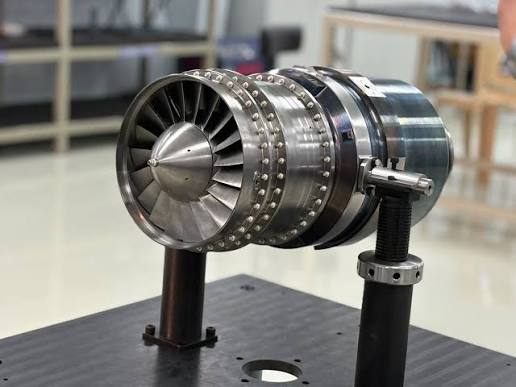
The first indigenous Expendable Turbo Jet Engine of 350 kg thrust class, designed by DRDO’s Gas Turbine Research Establishment (GTRE), has been successfully developed.
GTRE had identified Azad Engineering, Hyderabad as Industry partner for the manufacturing and assembly of the engine.
On July 22, 2026, the engine was successfully realised and delivered to GTRE by Azad Engineering, a landmark achievement for India’s aerospace and defence ecosystem.
The delivery marks the culmination of years of precision engineering, advanced manufacturing, and close partnership between India’s scientific & industrial communities.
Mastered by only a handful of nations, jet engine technology is widely regarded as one of the most sophisticated engineering disciplines in the world, demanding exceptional precision, advanced metallurgy, and uncompromising manufacturing standards.
Delivery of such complex system based on the design of DRDO reflects the growing technological capabilities of the Indian Defence Industry.
India’s first indigenous
This 350 kg thrust class Expendable Turbo Jet Engine will be used to power a range of defense applications, primarily cruise missiles, unmanned aerial vehicles (UAVs), loitering munitions, and target drones.
Expendable engines differ from reusable propulsion systems in lifespan, cost, materials, and maintenance requirements. Because they are built for one-way, short-duration missions, their entire design philosophy prioritizes cheap manufacturing over longevity.
Lifespan & Mission Cycle
Expendable Engines: Built for a single flight lasting from 15 minutes to a few hours. They operate continuously at maximum capacity until the asset impacts the target.
Reusable Engines: Engineered to operate for thousands of flight hours over decades. They undergo thousands of start-stop cycles, idle periods, and throttle adjustments.
Manufacturing Cost & Materials
Expendable Engines: Prioritize low-cost, easily machined materials like non-exotic alloys or composite plastics. They bypass expensive, long-term anti-corrosion coatings.
Reusable Engines: Utilize ultra-premium single-crystal superalloys and advanced thermal barrier coatings. These materials withstand prolonged, repeated thermal stress but drastically inflate production costs.
Design Tolerances & Safety Margins
Expendable Engines: Operate with razor-thin structural safety margins (1.1× to 1.25× yield strength). Since pilot safety is not a factor, components are pushed to their absolute physical limits.
Reusable Engines: Adhere to strict, redundant safety factors (1.5× to 2.0×+). They feature heavy containment casings to safely house catastrophic failures away from the airframe.
Maintenance & Storage
Expendable Engines: Require zero operational maintenance after assembly. They are sealed into storage containers and must maintain 100% reliability after sitting dormant for 5 to 10 years.