
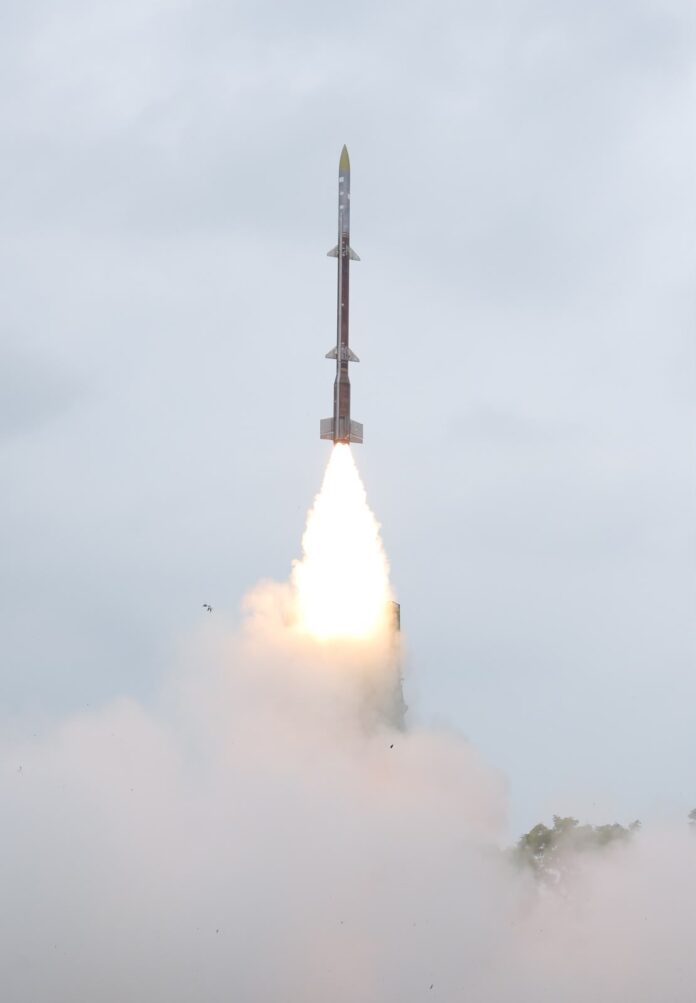
Defence Research & Development Organisation (DRDO) successfully conducted the maiden flight-test of ‘Kusha’ Long-Range Surface-to-Air Missile from the APJ Abdul Kalam Island off the coast of Odisha on July 23, 2026.
This maiden test was conducted against an electronic target simulating high-speed and high-altitude aerial threat which was successfully intercepted by the missile system.
The ‘Kusha’ missile system is capable of neutralising a wide variety of aerial threats including fighter jets, missiles, unmanned aerial vehicles and large enemy aircraft within a wide range & altitude envelope.
All weapon system elements, including the missiles, radars, command and control centre, have been developed by various DRDO laboratories and Industry partners.
Backgrounder on KUSHA missile
The Kusha Long-Range Surface-to-Air Missile (LR-SAM) successfully completed its maiden flight test from APJ Abdul Kalam Island, Odisha. Developed indigenously by the Defence Research and Development Organisation (DRDO), this advanced system is designed to provide India with a powerful, multi-layered air defence shield often compared to Russia’s S-400.
Key Capabilities and Features:
Target Profiles: Engineered to detect, track, and neutralize a wide spectrum of aerial threats. This includes fighter jets, drones, cruise missiles, stealth targets, and certain ballistic missiles.
Layered Interception: Part of the broader Project Kusha (or Extended Range Air Defence System), the network utilizes three interceptor variants:
M1: Features an engagement range of approximately 150 km.
M2: Extends defense coverage up to 250 km.
M3: Designed for long-range interception stretching between 350 km and 400 km.
Hypersonic Interceptors: The missiles are designed to travel at high speeds of around Mach 5.5.
System Integration: The network is built to plug directly into the Indian Air Force’s Integrated Air Command and Control Systems (IACCS). This allows real-time data fusion from multiple civilian and military radars.
Strategic Importance
Developed alongside key industry partners like Bharat Electronics Limited (BEL), the system forms the core long-range tier of India’s Mission Sudarshan Chakra. It aims to establish a comprehensive national air defense umbrella by 2035.
Phased testing will continue, with eventual military induction planned to roll out between 2028 and 2030.