
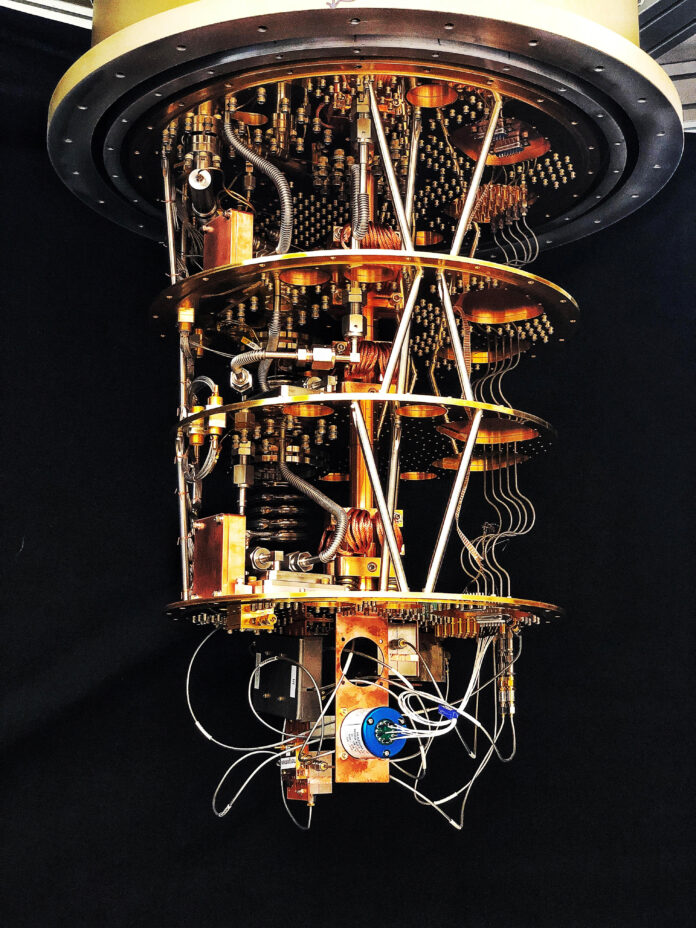
In a significant step towards building India’s strategic quantum technology ecosystem, the Defence Research and Development Organisation (DRDO) has signed its first high-value deep-tech project agreement under the Technology Development Fund (TDF) scheme for the indigenous development of a 20 millikelvin (mK) Dilution Refrigerator, a critical infrastructure component required for advanced quantum technologies.
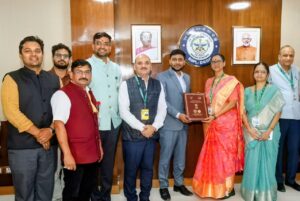
The agreement was signed between DRDO’s Technology Development Fund and Rajasthan-based start-up Zero mK India Private Limited in New Delhi on 24th of September 2026.
The project is the first major initiative to be funded from the Rs 500 crore deep-tech corpus approved by Defence Minister Rajnath Singh for cutting-edge defence and strategic technologies.
What is a 20 mK Dilution Refrigeration – simply it is a dilution refrigerator, a highly specialised cryogenic system capable of cooling equipment to temperatures as low as 20 millikelvin, or just 0.02 degrees above absolute zero. Such extreme cooling is essential for operating and testing quantum computing platforms, superconducting quantum devices and next-generation quantum sensors.
At these temperatures, thermal noise is almost eliminated, allowing delicate quantum states to remain stable for scientific and technological applications that are impossible under normal conditions.
According to a release by the Ministry of Defence (MoD), indigenous development of this capability will strengthen India’s technological self-reliance while reducing dependence on imported cryogenic infrastructure.
Strategic significance of this goes beyond quantum computing. While the dilution refrigerator itself is not a weapon system, defence experts view it as a foundational technology that can enable several future military capabilities.
The ultra-low temperature platform can support research and development in namely quantum computing, quantum communication networks, quantum sensors, quantum navigation systems, quantum cryptography and advanced military simulations.
These technologies are expected to play an increasingly important role in future warfare, where information dominance, secure communications and precision sensing could become decisive factors having potential military applications.
And what are they. In Quantum-Secure Communications area, one of the most immediate applications could be the development of highly secure military communication networks based on quantum technologies, significantly enhancing protection against interception and cyber threats.
Also, in ‘GPS-Independent Navigation’ field, the quantum sensors and quantum inertial navigation systems may eventually allow military platforms to operate without relying on GPS signals.
The potential users could include ballistic missile submarines, strategic missile systems, fighter aircrafts and long-range unmanned platforms
Such capabilities would be particularly valuable in contested environments where satellite navigation signals may be jammed or spoofed.
In the arena of ‘enhanced submarine detection’ such technologies that includes quantum magnetometers operating at extremely high sensitivity, could strengthen anti-submarine warfare capabilities by detecting minute disturbances in magnetic fields caused by underwater vessels.
Defence experts also add that in the sub-section of ‘Quantum Radar and Air Defence’, an area which is still under development globally, quantum radar technologies are being explored for detecting low-observable targets, including stealth aircraft and advanced cruise missiles, potentially supporting future air-defence and early-warning systems.
Missile Guidance and Strategic Systems – The technology could also contribute indirectly to future precision-guidance systems through quantum gyroscopes and highly accurate inertial navigation technologies.
In the longer term, strategic systems such as ballistic missiles, submarine-launched missiles, ballistic missile defence networks and future air-defence architectures could benefit from advances emerging from India’s quantum technology ecosystem.
The Ministry of Defence said the indigenous development of a 20 mK-class dilution refrigerator aligns with the objectives of the National Quantum Mission and will strengthen national capabilities in quantum technology, advanced cryogenics and strategic research.
The project will be monitored and mentored by the Solid State Physics Laboratory (SSPL), one of DRDO’s key establishments working in advanced electronics and quantum-related technologies.
Defence Minister Rajnath Singh congratulated DRDO, industry partners and all stakeholders involved in the project, expressing confidence that the initiative would set a strong precedent for future DRDO-industry collaboration in emerging technology domains.
Defence Secretary and DRDO Chairman Rajesh Kumar Singh also congratulated the teams associated with the project and wished them success in achieving the programme objectives.
Much like a wind tunnel is essential for aerospace development, a dilution refrigerator is critical infrastructure for the quantum age.
While it may never appear on a battlefield, the technologies enabled by it could shape the future of secure military communications, advanced sensing, navigation, cyber security, missile guidance and strategic deterrence.
For India, the project represents more than a scientific milestone. It marks an important step towards building a self-reliant, quantum-ready defence ecosystem capable of supporting the next generation of military technologies.