
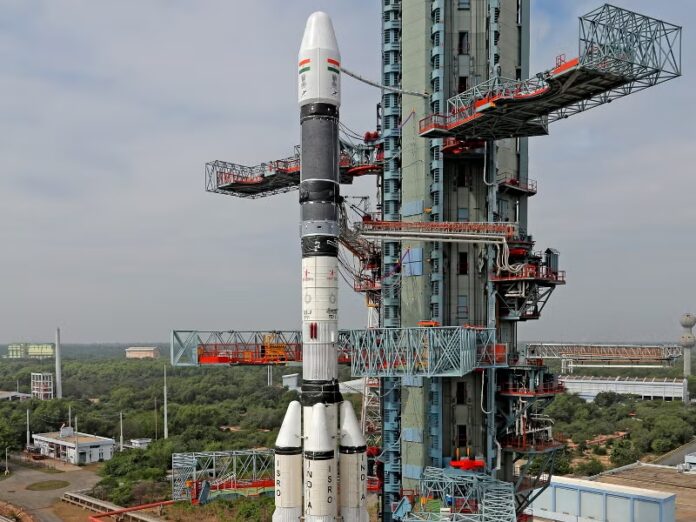
In a significant boost to India’s military modernisation efforts, the Ministry of Defence (MoD) on Wednesday signed contracts worth ₹4,106 crore for the acquisition of the GSAT-7C communication satellite for the Indian Air Force and Varunastra heavyweight torpedoes for the Indian Navy.
The contracts, signed in the presence of senior defence officials, include a ₹2,563-crore agreement with NewSpace India Limited (NSIL) for GSAT-7C and a ₹1,543-crore contract with Bharat Dynamics Limited (BDL) for the procurement of indigenously developed Varunastra heavyweight torpedoes.
The twin deals underline India’s growing emphasis on strengthening capabilities in two increasingly decisive domains of modern warfare: secure military communications in space and anti-submarine operations beneath the sea.

GSAT-7C to Strengthen IAF’s Network-Centric Warfare Capabilities
The GSAT-7C communications satellite is expected to provide the Indian Air Force (IAF) with a dedicated and secure satellite communication network, enabling seamless connectivity among its airborne and ground-based assets across vast operational distances.
The satellite is designed to support secure beyond-line-of-sight communications and facilitate network-centric operations involving fighter aircraft, transport fleets, airborne early warning platforms, UAVs, air defence systems and command-and-control nodes.
Defence experts view the project as a critical component of India’s evolving military space architecture. The satellite will complement existing strategic communication satellites, including GSAT-7 “Rukmini” for the Navy and GSAT-7A for the Air Force and Army Aviation Corps, while contributing to a dedicated military satellite network.
In a future conflict environment, secure satellite communications are expected to play a decisive role by enabling:
- Real-time exchange of operational data between aircraft and command centres.
- Connectivity for airborne early warning and control systems.
- Extended-range control of unmanned aerial vehicles.
- Secure and resilient communications in electronically contested environments.
- Faster dissemination of targeting and battlefield information.
Military planners increasingly regard protected communications networks as a force multiplier, allowing dispersed assets to operate as part of a unified combat network.
Varunastra to Enhance Navy’s Anti-Submarine Warfare Capability
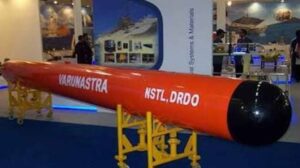
The second contract covers the procurement of Varunastra, India’s indigenous heavyweight torpedo developed by the Defence Research and Development Organisation’s Naval Science and Technological Laboratory (NSTL).
Varunastra is among the most advanced underwater weapons developed in India and is designed primarily for engaging enemy submarines.
The torpedo is equipped with advanced acoustic homing capabilities and can operate against hostile submarines across varying underwater conditions.
Publicly available specifications indicate that Varunastra features:
- A diameter of 533 mm.
- A length of approximately 7.8 metres.
- A warhead weighing around 250 kg.
- Electric propulsion.
- Speeds of up to 40 knots.
- An operational range of around 40 km.
- Target engagement capability at depths reaching approximately 600 metres.
The procurement assumes particular significance against the backdrop of increasing submarine activity in the Indian Ocean Region, including the growing deployment footprint of the Chinese People’s Liberation Army Navy and Pakistan Navy’s ongoing submarine modernisation programmes.
Supporting Fleet Expansion and Operational Readiness
While the Ministry of Defence has not disclosed the number of torpedoes being acquired, defence observers believe the contract will support both the equipping of frontline warships and the replenishment of operational inventories.
The Indian Navy is currently inducting and preparing multiple frontline platforms, including:
- Nilgiri-class stealth frigates.
- Visakhapatnam-class destroyers.
- Future surface combatants under various indigenous programmes.
The new torpedo order is expected to strengthen the Navy’s underwater warfare preparedness while supporting long-term operational requirements.
Boost for Indigenous Defence Industry
The contracts also highlight the increasing role of Indian industry in delivering strategic military capabilities.
For NSIL, the commercial arm of ISRO, the GSAT-7C project represents a major strategic space programme and reflects India’s growing commitment to sovereign military satellite capabilities.
For Bharat Dynamics Limited, already a key participant in several missile and weapon programmes, the Varunastra order is expected to strengthen its order book while advancing indigenous underwater weapon production capabilities.
The contracts align with the government’s broader push toward self-reliance in defence manufacturing under the Atmanirbhar Bharat initiative and follow a series of recent procurements involving indigenous missile systems, precision-guided weapons, sensors and defence electronics.
Strategic Significance
Although announced as separate acquisitions, the two contracts are linked by a common objective: enhancing India’s ability to fight and coordinate across increasingly contested domains.
While GSAT-7C will strengthen command, control and secure communications from space, Varunastra will reinforce the Navy’s ability to detect, track and neutralise submarine threats underwater.
Together, the ₹4,106-crore package represents an investment not merely in platforms and equipment, but in two critical pillars of future warfare: information superiority and undersea dominance.