
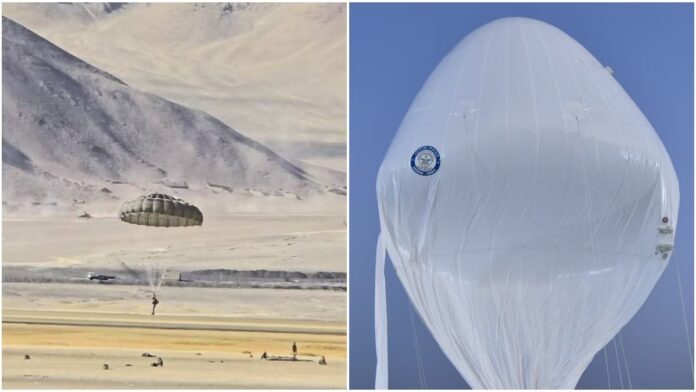
The Defence Research and Development Organisation (DRDO) has successfully conducted a flight trial of its indigenously developed High-Altitude Platform System (HAPS), achieved an altitude of 21 km and maintained stable flight at around 20 km for over 30 minutes.
The test, carried out by DRDO’s Aerial Delivery Research and Development Establishment (ADRDE), Agra, marks a significant milestone in India’s efforts to develop long-endurance stratospheric platforms capable of providing persistent aerial surveillance and other strategic capabilities.
In an another related DRDO development –
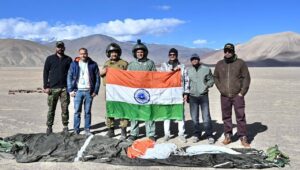
The Defence Research and Development Organisation (DRDO) has successfully carried out the maiden live jump of the indigenously developed Advanced High-Altitude Parachute (AHAP) at Nyoma in Ladakh, one of the world’s highest-altitude drop zones.
The trial was conducted at an altitude of 16,000 feet above mean sea level (AMSL), with the parachute deployed at 15,500 feet. The paratrooper subsequently landed safely at the Nyoma (Mudh) Drop Zone, situated at an altitude of 13,700 feet.
The successful demonstration validated the effectiveness and tactical employability of the AHAP system in extremely high-altitude conditions, a critical operational requirement for the Indian Armed Forces.
Designed and developed by DRDO’s Aerial Delivery Research and Development Establishment (ADRDE), Agra, the Advanced High-Altitude Parachute is a static-line parachute system intended for the mass deployment of paratroopers in challenging terrain and operational environments.
The system has been manufactured by the Ordnance Parachute Factory (OPF), Kanpur, inspected by the Directorate General of Aeronautical Quality Assurance (DGAQA), and certified by the Centre for Military Airworthiness and Certification (CEMILAC) through RCMA Kanpur.
According to DRDO, the AHAP offers multiple deployment modes and features a wide operational altitude envelope of up to 18,000 feet. The parachute is designed to provide a safer rate of descent, making it particularly suitable for military operations in high-altitude regions.
Static-line parachute operations at such elevations are considered highly complex and inherently risky due to the severe opening shock experienced during deployment and the increased rate of descent in thin air conditions. The successful live jump therefore marks a significant technological and operational achievement.
According to DRDO, the experimental platform was brought down under controlled conditions after successfully maintaining the designated altitude. The system was subsequently recovered, and data gathered during the mission is currently being analysed to evaluate overall performance and validate various onboard subsystems.
During the flight, real-time video feeds and vehicle telemetry data were transmitted to a Ground Control Station. The platform carried a range of instrumentation and control systems, including an Inertial Measurement Unit (IMU), GPS receiver, onboard cameras, and an altitude-control mechanism.
Unlike conventional aircraft, HAPS platforms function as high-altitude pseudo-satellites operating in the stratosphere for extended durations. Their ability to remain at very high altitudes for prolonged periods could provide the armed forces with persistent surveillance, communications, and intelligence-gathering capabilities, depending on the payload and operational configuration.
The Defence Ministry said the flight trial was conducted with the participation of the Indian Air Force (IAF), Centre for Military Airworthiness and Certification (CEMILAC), Directorate General of Civil Aviation (DGCA), Airports Authority of India (AAI), and other civil authorities.
DRDO describes the platform as a lighter-than-air system being developed as a long-endurance stratospheric aerial surveillance platform. The latest trial was aimed at expanding the flight envelope and validating critical technologies required for the development of an operational system.
The successful demonstration is expected to accelerate India’s efforts to field indigenous high-altitude platforms that can complement satellites and conventional airborne systems in surveillance, communications, and strategic reconnaissance roles.